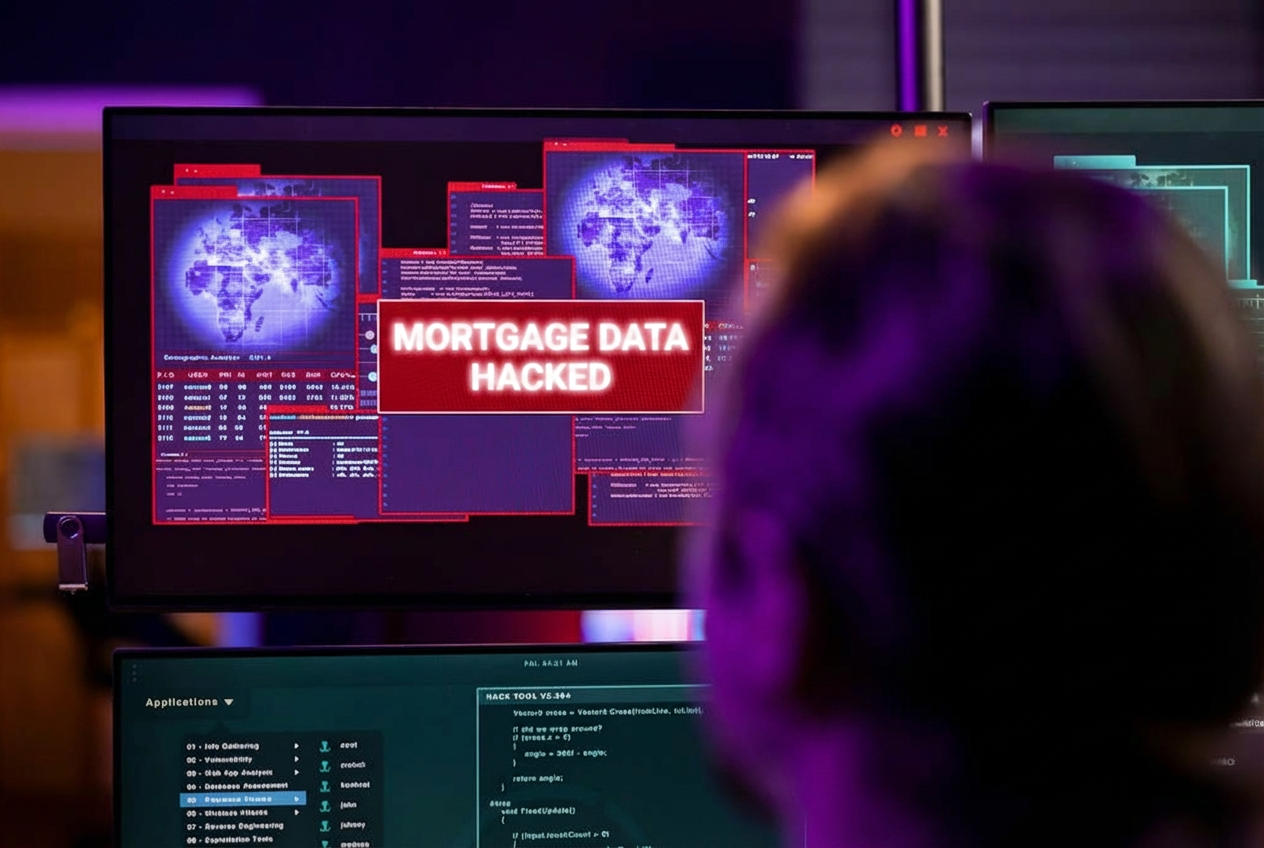
Mortgage lenders hold the exact combination of assets that ransomware operators prize most: high-value transaction data, personally identifiable information (PII) on borrowers, and operational systems that cannot afford downtime during rate-sensitive periods. In 2024, the mortgage industry experienced it’s highest level of ransomware attacks, with 65% of financial services organizations stating they had been hit, according to a Sophos report. This isn’t coincidental. Ransomware groups have identified mortgage companies as uniquely vulnerable targets where the pressure to pay is highest and the security posture is often weakest.
The LoanDepot breach in January 2024 demonstrated exactly why mortgage lenders have become priority targets. The ALPHV/BlackCat ransomware group encrypted systems holding loan servicing data for approximately 16.6 million customers, forcing the company offline for weeks during peak refinancing season. LoanDepot faced a reported $27 million in direct costs, but the operational impact was far more severe: loan officers couldn’t access files, closings were delayed indefinitely, and borrowers in time-sensitive transactions lost rate locks. The attackers understood that mortgage companies operate on razor-thin margins during specific market windows, and that every day of downtime translates directly to revenue loss and regulatory exposure.
What makes mortgage companies particularly attractive to ransomware operators goes beyond the data they hold. It’s the convergence of regulatory pressure, operational fragility, and authentication weaknesses that creates the perfect extortion scenario.
What Makes Mortgage Companies More Vulnerable Than Other Financial Institutions?
Mortgage lenders occupy a unique position in the financial services ecosystem that amplifies their ransomware risk. Unlike banks with diversified revenue streams, mortgage companies derive nearly all income from origination and servicing fees tied to specific transaction timelines. When ransomware locks their systems, they cannot pivot to other business lines. Every hour of downtime means missed rate locks, failed closings, and borrowers who move to competitors.
The operational model compounds this vulnerability. Mortgage companies rely on complex integrations between loan origination systems (LOS), customer relationship management (CRM) platforms, document management systems, and third-party services for credit checks, appraisals, and title searches. This sprawling attack surface creates multiple entry points for initial access brokers, the specialized criminals who sell network access to ransomware operators.
Authentication practices at many mortgage companies remain stuck in 2015. Password-based access controls, often with minimal multi-factor authentication (MFA) enforcement, protect systems containing complete financial profiles, tax returns, bank statements, and identity documents. When employees reuse passwords across personal and work accounts (a behavior observed in 62% of people in the United States according to a 2025 NordPass survey), a single credential compromise can provide ransomware operators with legitimate access to core systems.
The workforce structure adds another layer of risk. Mortgage companies employ large numbers of loan officers, processors, and underwriters who work remotely or in distributed branch offices. These users require access to sensitive systems from multiple locations and devices, creating authentication challenges that many companies solve by weakening security rather than implementing proper passwordless controls. VPN access protected only by passwords and SMS-based MFA has become the standard entry point for ransomware attacks targeting mortgage lenders.
How Did ALPHV/BlackCat Specifically Target the Mortgage Industry?
The ALPHV/BlackCat ransomware group, also known as Noberus, demonstrated sophisticated understanding of mortgage industry operations in their 2024 campaign. Rather than employing spray-and-pray tactics, they conducted targeted reconnaissance to identify mortgage companies during high-volume periods when the cost of downtime would be maximized.
Their attack methodology followed a consistent pattern. Initial access typically came through phishing campaigns that bypassed traditional email security by using legitimate cloud services like Microsoft SharePoint or Google Drive to host malicious payloads. These campaigns targeted loan officers and processors with messages that appeared to come from real estate agents or title companies, often including actual transaction details scraped from public MLS listings to increase credibility.
Once an employee clicked through and entered credentials on a fake login page, the attackers had valid authentication tokens. Because most mortgage companies relied on password-based access or legacy MFA that could be phished (like SMS codes or push notifications), the attackers could authenticate as legitimate users without triggering security alerts.
After establishing initial access, ALPHV operators moved laterally through the network, specifically targeting backup systems, disaster recovery infrastructure, and administrative accounts. They understood that mortgage companies often maintain incomplete or outdated backups due to the massive data volumes involved in loan servicing. By encrypting both production systems and backups simultaneously, they eliminated the victim’s ability to restore operations without paying the ransom.
The encryption itself was timed for maximum impact. ALPHV typically triggered their ransomware payloads on Friday evenings or during month-end periods when loan closing volumes peak. This timing forced mortgage companies into impossible decisions: pay the ransom immediately to restore operations, or face cascading failures as closings collapsed and borrowers filed complaints with the Consumer Financial Protection Bureau (CFPB).
What distinguished ALPHV’s mortgage attacks was their use of triple extortion. Beyond encrypting systems and threatening to leak stolen data, they contacted individual borrowers whose information had been compromised, creating direct pressure from customers and regulators. This tactic proved particularly effective against mortgage servicers who face strict data breach notification requirements under the Gramm-Leach-Bliley Act (GLBA).
Why Do Password-Based Systems Fail to Protect Mortgage Data?
The fundamental problem with password-based authentication in mortgage environments is that it creates a shared secret that can be stolen, phished, or replayed. When a loan officer enters their username and password, that credential is transmitted and validated against a stored version in the company’s authentication system. If an attacker intercepts that credential through phishing, keylogging, or a man-in-the-middle attack, they possess everything needed to authenticate as that user.
Legacy multi-factor authentication doesn’t solve this problem, it just adds steps. SMS-based codes can be intercepted through SIM swapping attacks, a technique that costs attackers approximately $100 per phone number according to recent underground market pricing. Push notification MFA falls to “MFA fatigue” attacks where attackers spam users with authentication requests until they approve one just to stop the notifications. Time-based one-time passwords (TOTP) from authenticator apps can be phished using adversary-in-the-middle (AiTM) proxy sites that capture both the password and the TOTP code in real-time.
The mortgage industry’s specific workflows make these authentication weaknesses more exploitable. Loan officers frequently access systems from personal devices, coffee shops, and client offices. They share documents through email and cloud storage. They communicate with dozens of external parties per transaction, each interaction creating potential phishing vectors. When the authentication protecting these activities relies on passwords, even with legacy MFA, it becomes a matter of when, not if, credentials will be compromised.
The LoanDepot breach illustrated this perfectly. The attackers didn’t exploit a zero-day vulnerability or conduct sophisticated network penetration. They used phished credentials to authenticate as legitimate users, then moved through the network using additional compromised accounts. The security systems saw valid logins from recognized users and raised no alarms.
Password managers and security awareness training, while helpful, cannot eliminate the fundamental vulnerability. Password managers still require a master password that can be phished. Security awareness training cannot prevent 100% of employees from ever clicking a malicious link, especially when attackers use convincing pretexts involving real transactions. The only way to eliminate credential phishing is to eliminate credentials that can be phished.
What Authentication Standards Actually Stop Ransomware Initial Access?
Modern authentication standards are designed to eliminate the shared secret vulnerability at the root of credential-based attacks. Unlike passwords or legacy MFA, decentralized and cryptography-based authentication solutions leverage private key never leaves the user’s device and it cannot be transmitted or phished. BlokSec’s architecture adheres to these same cryptographic principles with a unique design built around immutable key storage and deviceless authentication that open ecosystem (such as WebAuthn) cannot support.
When a loan officer authenticates, their device generates a cryptographic signature using a private key stored in secure hardware. This signature is sent to the authentication server, which validates it using the corresponding public key. An attacker who intercepts this signature cannot reuse it because each signature is unique to that specific authentication attempt and cryptographically bound to the origin domain.
This means phishing sites cannot capture reusable credentials. Even if an attacker creates a perfect replica of your mortgage LOS login page, a properly bound authentication credential will fail against the fraudulent domain. The user cannot accidentally authenticate to the fake site, even if they want to.
For mortgage companies, eliminating credential-based authentication eliminates the primary initial access vector that ransomware operators rely on. Without the ability to phish credentials, attackers must resort to far more expensive and detectable techniques like exploiting unpatched vulnerabilities or physically compromising devices. This dramatically increases the cost and risk for attackers while reducing the attack surface for defenders.
What Does Ransomware Recovery Actually Cost Mortgage Companies?
The public ransom payment represents only a fraction of total ransomware costs for mortgage companies. LoanDepot’s $27 million in disclosed costs included ransom payment, incident response, forensic investigation, and legal fees, but excluded the operational revenue lost during weeks of system downtime.
Mortgage companies operate on origination margins of 50 to 100 basis points per loan. When ransomware forces a shutdown during a refinancing wave or home-buying season, the revenue impact compounds rapidly. A mid-sized mortgage lender originating $200 million monthly faces approximately $2 million in lost origination revenue per week of downtime, plus the permanent loss of borrowers who move to competitors.
Servicing portfolios face different but equally severe impacts. Mortgage servicers must continue making payments to investors even when ransomware prevents them from collecting from borrowers. A servicer managing a $10 billion portfolio might face $40 million in monthly payment obligations that continue regardless of operational status. The longer systems remain encrypted, the larger the cash flow gap becomes.
Regulatory penalties add another cost layer. The CFPB has increased scrutiny of mortgage companies’ cybersecurity practices following recent breaches, with consent orders requiring enhanced security controls and third-party audits. State regulators can suspend lending licenses if they determine a company cannot adequately protect consumer data. These regulatory actions can effectively end a mortgage company’s ability to operate, making them potentially more costly than the ransomware attack itself.
Customer remediation costs extend for years after the initial breach. Mortgage companies must provide credit monitoring for affected borrowers, staff call centers to handle inquiries, and defend against class-action lawsuits alleging inadequate data protection. The reputational damage affects referral networks, as real estate agents and builders become reluctant to recommend a lender with recent security failures.
The total cost of a ransomware attack for a mortgage company typically reaches 8 to 12 times the ransom payment itself when all direct and indirect costs are included. For a company facing a $4 million ransom demand, the all-in cost often exceeds $40 million.
How Should Mortgage Companies Prioritize Ransomware Defense Investments?
Authentication represents the highest-ROI security investment for mortgage companies because it addresses the initial access vector that enables 80% of ransomware attacks. Implementing passwordless authentication across all user access points creates an immediate, measurable reduction in attack surface.
The implementation priority should follow the data sensitivity and access frequency hierarchy. Start with privileged accounts that can access core systems, backup infrastructure, and administrative functions. These accounts represent the highest-value targets for ransomware operators conducting lateral movement. Extending passwordless authentication to these accounts first provides the greatest risk reduction per user.
Next, deploy passwordless authentication to loan officers, processors, and underwriters who access loan origination systems and customer data. These users represent the largest phishing target surface and the most common initial access point. Because they work remotely and access systems from varied locations, they benefit most from authentication that works seamlessly across devices while eliminating phishing risk.
Finally, extend passwordless authentication to third-party integrations and API access. Mortgage companies share data with credit bureaus, appraisal management companies, title companies, and investor platforms. Each integration point that relies on API keys or service account passwords creates potential compromise vectors. Implementing FIDO2-based service authentication eliminates these shared secrets.
Beyond authentication, mortgage companies should prioritize offline, immutable backups that ransomware cannot encrypt. This means physically air-gapped systems or write-once storage that cannot be modified even with administrative credentials. Regular testing of backup restoration procedures ensures that backups actually work when needed.
Network segmentation that isolates loan origination systems from servicing platforms, and both from corporate IT infrastructure, limits the blast radius of successful intrusions. If ransomware operators gain access to one segment, proper segmentation prevents lateral movement to other critical systems.
Endpoint detection and response (EDR) tools provide visibility into suspicious behavior patterns that might indicate ransomware deployment. However, EDR should be viewed as a detection and response control, not a prevention control. By the time EDR detects ransomware behavior, encryption may have already begun.
The most cost-effective ransomware defense strategy for mortgage companies inverts the traditional security spending model. Instead of investing heavily in detection and response tools that activate after compromise, invest in authentication controls that prevent the initial access that makes ransomware possible. When attackers cannot phish their way into your network, the entire ransomware kill chain breaks down.
FAQ: Mortgage Company Ransomware Risks
Why are mortgage companies targeted more than banks?
Mortgage companies operate on thinner margins and tighter timelines than diversified banks, making downtime more immediately costly. They also typically have smaller security teams and budgets than large banks, while holding equally valuable data. Ransomware operators have learned that mortgage companies are more likely to pay quickly due to operational pressure and less likely to have robust backup and recovery capabilities.
Can cyber insurance protect mortgage companies from ransomware costs?
Cyber insurance covers some ransomware costs but increasingly excludes payments to sanctioned ransomware groups and requires proof of specific security controls before paying claims. Insurers now mandate MFA implementation, offline backups, and incident response planning as policy requirements. Even with coverage, deductibles and coverage limits mean mortgage companies still face substantial out-of-pocket costs. Insurance should be viewed as risk transfer for residual exposure, not as a replacement for proper security controls.
What regulations require mortgage companies to prevent ransomware?
The Gramm-Leach-Bliley Act requires financial institutions, including mortgage companies, to implement safeguards protecting customer information. The FFIEC Cybersecurity Assessment Tool specifically addresses authentication controls and ransomware resilience. State data breach notification laws require disclosure of compromises, and the CFPB has indicated it will use its supervisory authority to examine mortgage companies’ cybersecurity practices. While no regulation explicitly mandates specific anti-ransomware technologies, the requirement to protect customer data effectively mandates controls that prevent common attack vectors.
How long does ransomware recovery take for mortgage companies?
Recovery timelines vary based on backup availability and attack scope, but mortgage companies typically face 2 to 6 weeks of significant operational disruption even with good backups. Complete recovery, including forensic investigation, system hardening, and regulatory response, often takes 3 to 6 months. Companies without proper backups may face months of complete shutdown or be forced to rebuild systems entirely from scratch. The LoanDepot attack resulted in approximately 3 weeks of major system unavailability and ongoing operational impacts for months afterward.
Does passwordless authentication work with legacy mortgage systems?
Modern passwordless authentication integrates with legacy systems through standard protocols like SAML, OAuth, and OpenID Connect. Most loan origination systems and servicing platforms support these federation standards, allowing passwordless authentication at the identity provider level even when the underlying application wasn’t built with passwordless architecture in mind. BlokKey plugs into your existing identity infrastructure at this federation layer, so your LOS, servicing platform, or document management system doesn’t require a rebuild or vendor-side changes to benefit from phishing-resistant authentication.
For systems that cannot support federation protocols, passwordless authentication can protect VPN and remote desktop access, creating a hardened perimeter around legacy applications without requiring any changes to the applications themselves. For frontline mortgage workers who share workstations or operate without dedicated devices, BlokBadge extends this protection through badge-tap authentication that requires no device enrollment.
The integration path depends on your specific stack, but passwordless authentication can protect access to virtually any mortgage technology environment, from modern cloud-based LOS platforms to decade-old on-premise servicing systems.