How One Stolen Credential Can Take Down a Mortgage Operation
It starts with an email.
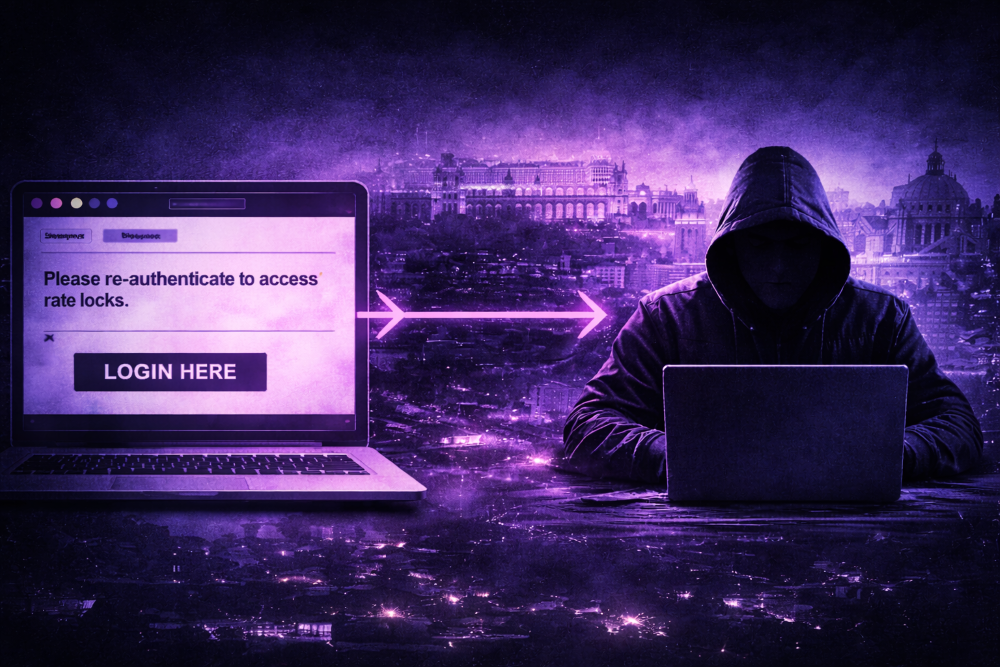
Nothing dramatic. No skull-and-crossbones icon, no urgent subject line demanding immediate action in red capital letters. Just a routine-looking message from what appears to be your secondary market investor portal, asking the loan officer to re-authenticate before accessing rate lock confirmations. The link looks right. The logo looks right. The login page looks right.
Twenty seconds later, a set of Encompass credentials belongs to someone in a server farm outside Bucharest.
What happens next is not a hypothetical. It is a composite of real incidents reported to the CFPB, state attorneys general, and cybersecurity firms between 2022 and 2025. The details change. The outcome rarely does.
The Attack Chain: From Inbox to Wire
After the initial phishing capture, the attacker does not immediately move. Skilled threat actors with financial sector targeting tend to dwell. They observe. Over the next 24 to 72 hours, the compromised account watches email patterns, learns internal terminology, identifies open loans, and maps the org chart by reading thread participants.
By the time anyone notices unusual behavior, the attacker has already:
Located three loans in the closing queue with wires scheduled in the next five business days.
Identified the escrow officer and the borrower’s email addresses.
Learned the internal format for wire transfer confirmations.
Now comes the wire fraud. A spoofed email thread, indistinguishable from internal communication, instructs the escrow officer to redirect the wire to updated banking coordinates. The borrower receives a parallel email that appears to come from the loan officer, confirming the change. Both trust it. Both act on it.
The wire goes out. The funds are gone within hours, often split across mule accounts before anyone realizes something is wrong.
The Regulatory Fallout
Wire fraud is expensive. In 2023, the FBI reported that real estate wire fraud cost Americans over $446 million. But for a mortgage company, the damage extends well beyond the dollar amount on any single transaction.
When a breach involves borrower financial data, GLBA notification obligations kick in immediately. Under the FTC Safeguards Rule, firms must notify the FTC within 30 days of discovering a breach affecting 500 or more customers. State-level requirements, particularly in New York under NYDFS Part 500, are even more demanding.
Then comes the investigation. Regulators want to see your incident response plan, your access logs, your authentication records. They want to know who had access to what, when, and how that access was protected. If the answer is ‘a username and password, sometimes with an SMS code,’ prepare for a difficult conversation.
Legal exposure follows. Depending on state law and the specific facts, the company may face liability to the borrower for failing to maintain adequate security. Outside counsel gets expensive fast. Cyber insurance carriers, if coverage applies, will conduct their own forensic investigation before paying out, adding months to the resolution timeline.
One stolen credential. One phishing email. Six figures in direct loss, a regulatory investigation, potential litigation, and a press cycle that reaches every referral partner you have.
Where Traditional MFA Falls Short
The natural question at this point is: what about multi-factor authentication? Most companies in this scenario had MFA deployed. Some had SMS-based codes. Others used authenticator apps. A few had hardware tokens for certain privileged users.
None of it mattered, for a specific reason.
Traditional MFA, including SMS codes and TOTP authenticators, is vulnerable to real-time phishing. An attacker can stand up a proxy site that captures credentials and the MFA code simultaneously, then uses them before the code expires. This technique, documented extensively by security researchers and used in attacks on financial institutions, is not exotic. It requires no special hardware. It is executed daily.
The Lapsus$ group demonstrated this approach at scale in 2022, compromising organizations with sophisticated security programs. The 2023 MGM breach involved a variant of the same technique, applied through social engineering to a help desk rather than a phishing page. The vector changes. The underlying weakness is the same.
MFA as currently deployed does not guarantee that the person authenticating is the legitimate user. It only guarantees that the legitimate user’s phone was present at some point in the past when the session was set up.
The Architectural Alternative
Phishing-resistant authentication does not patch the problem. It removes the attack surface entirely.
BlokKey leverages cryptographic challenge-response rather than shared secrets. There is no password to steal. There is no one-time code to intercept. The credential is bound to a specific device and a specific domain, which means a convincing phishing page cannot capture anything useful. Even if the employee types their username and clicks submit on a fraudulent site, the authentication handshake fails because the domain does not match.
This is not a better lock. It is a different door. The entire category of attack described above, phishing credentials, replaying them, real-time MFA bypass, none of it works against a properly implemented passwordless architecture.
For a mortgage company with 50 to 500 employees, the practical implication is significant. Your loan officers, underwriters, processors, and closers all operate in high-value transaction environments. They handle financial data that is worth money to criminals who are organized, patient, and technically capable. The credential infrastructure that protects access to your LOS, your document management platform, your email, and your wire confirmation workflows is not a commodity IT problem. It is a direct business risk.
What a Passwordless Response Would Have Looked Like
In the scenario above, a loan officer using BlokKey would have visited the phishing site and entered their email address. That is where the attack would have stopped. Because BlokKey relies on domain-bound, digital signature-based authentication tied to a decentralized identity, the fraudulent site would have been unable to generate a valid authentication challenge. The attacker would have no registered public key to validate against and no way to trigger a legitimate authentication flow. There is no shared secret. No reusable credential. No code to intercept. The private key never leaves the user’s device and cannot be replayed on a look-alike domain.
- The phishing page collects an email address and nothing more.
- No credential to harvest.
- No session to hijack.
- No transaction to approve.
- The attack ends at the fake login page instead of escalating into wire fraud or foreclosure.
That is the difference between password-based authentication and provable, cryptographic identity.
What to Do Next
If you are a CISO or security leader at a mortgage firm and this scenario sounds plausible for your environment, the starting point is an honest assessment of your current authentication posture. Not just whether MFA is deployed, but what kind, against which systems, with what enforcement gaps.
The FTC Safeguards Rule requires that MFA be applied to customer financial information. It does not specify the type. But regulators are increasingly aware that SMS and TOTP codes do not provide the protection the rule intends. Future enforcement actions will reflect that awareness.
BlokSec offers a no-obligation review of your current authentication architecture against the threat model described here. The goal is not to sell you something. It is to show you, concretely, where the exposure is and what it would take to close it.
Want to explore further? Download the full whitepaper below.